EU AI Act Consulting: Comply with the AI Regulation Easily and Securely

With the EU AI Act, the EU provides clarity for the use of AI systems in companies. Proliance's AI experts support you in efficiently implementing the requirements.
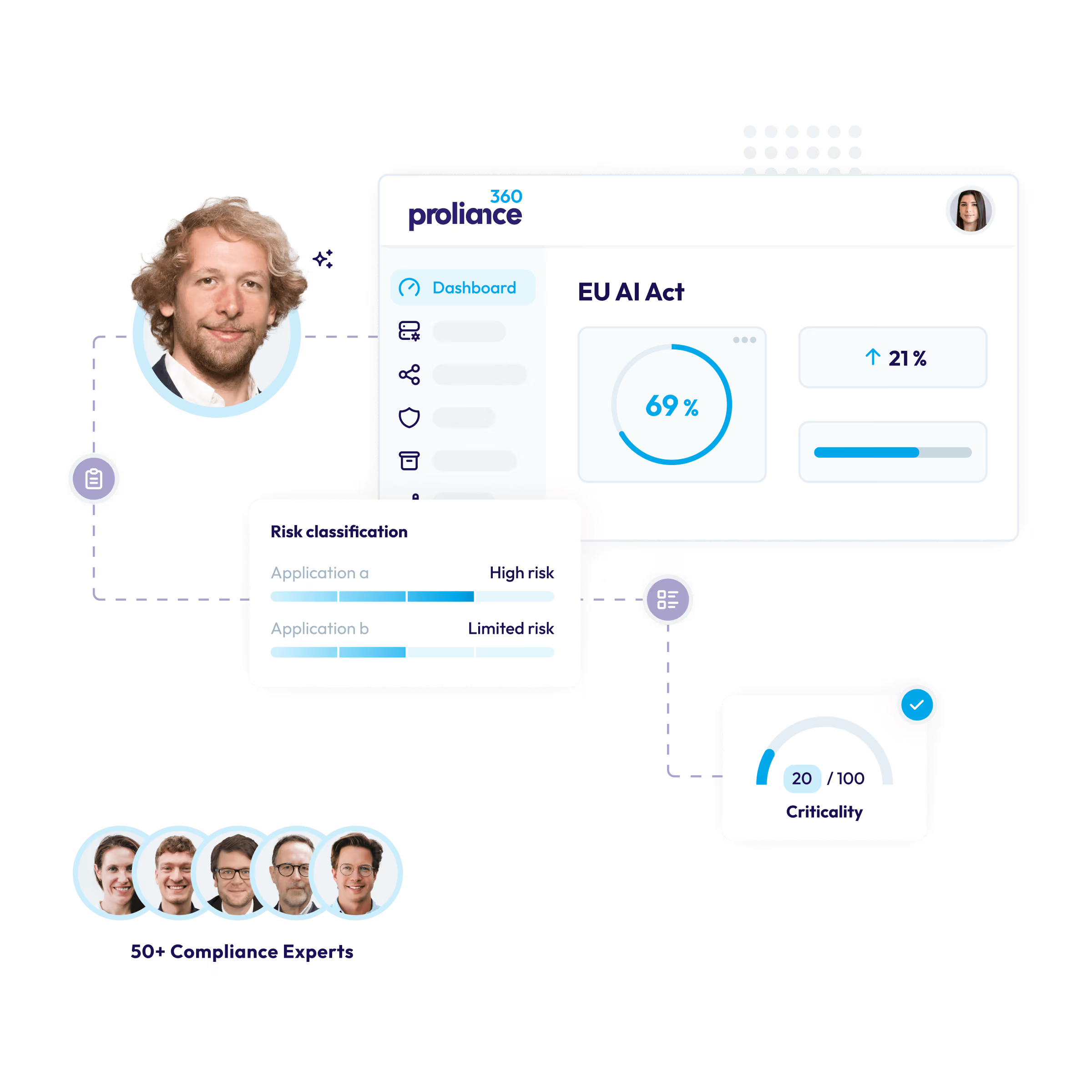
Schaltkreisdiagramm zeigt Proliance Frameworks verbunden mit DSGVO, ISO Standards, NIS2, TISAX, DORA und mehr.
Hosting in Europe
Documentation via Software
Certified AI Experts
These Customers Have Mastered Data Protection, Information Security, and AI Expertise with Our Offering
Why Proliance?

With Proliance, you use AI in compliance with the EU AI Act
Risk of Non-Compliance with the AI Regulation

  • Errors in Risk Classification of AI Systems within the Company
  • High Documentation and Auditing Effort
  • Lack of trust from customers & employees
  • Competitive disadvantages due to inhibited innovation
  • Risk of fines for non-compliance

Benefits of consulting with Proliance

  1. Clarity in risk assessment
  2. Proven AI Governance Processes
  3. Experts provide expertise and tools for efficient implementation
  4. A variety of templates for legally compliant and efficient processing & documentation
  5. Actionable recommendations provide security for AI projects
  6. Security through AI Compliance
Do I need consulting for EU AI Act implementation?

You've come to the right place if...

your company uses AI systems in its daily operations
you are unsure whether the AI regulation is relevant to your company
you lack the resources for EU AI Act compliance
you use high-risk AI systems and must ensure strict compliance with regulations
Arrange a consultation

AI Act consulting pays off – especially for SMEs

An estimated 160,000 SMEs in Germany must comply with the requirements of the EU AI Act. The financial pressure is significant: Violations of high-risk AI regulations can result in fines of up to €15 million or 3% of global annual turnover. In addition, there are ongoing compliance costs and one-time costs for conformity assessments for certain AI systems. Experts estimate that these costs can amount to approximately 10% of an AI project's development costs. AI Act consulting helps reduce the risk of violations and keep costs under control.
60+ experts
Book a consultation
Ein lächelnder Mann mit kurzen braunen Haaren sitzt in einem weißen Hemd auf einem Stuhl vor einem Fenster.
Your benefits

With Proliance, you use AI securely and remain productive

100
%
Tailored advice
tailored to your AI challenges and resources
More
Legal certainty
by ensuring accurate risk classification and clarity regarding obligations
20
+
TÜV & DEKRA certified experts
individually support you and your team
2,500
+
Client Projects
We understand your industry challenges
customer experiences

What 2,500+ Companies Value Most About Proliance

We have been implementing our annual data protection training through Proliance for years – this provides us with a clearly structured framework for knowledge transfer. Particularly with the use of AI in our teams, we specifically supplement the training where new requirements emerge. This ensures that responsibilities, risks, and legal frameworks remain transparent.
alphaQuest is extremely satisfied with the collaboration. Their professional approach and deep expertise are truly impressive. This gives us confidence that our sensitive data is handled securely. This partnership provides us with peace of mind and the assurance that we can focus on our core business.
Finally, I have a professional who reliably handles my data protection matters: Proliance – incredibly well-organized, quick, and always very friendly!
Proliance helped us take our company's data protection to the next level. The team's expertise and quick responsiveness supported us every step of the way. Highly recommended.
We were looking for a professional, comprehensive data privacy solution. With Proliance, we are in good hands and receive comprehensive advice!
We have been implementing our annual data protection training through Proliance for years – this provides us with a clearly structured framework for knowledge transfer. Particularly with the use of AI in our teams, we specifically supplement the training where new requirements emerge. This ensures that responsibilities, risks, and legal frameworks remain transparent.
EU AI Act Consulting Process

3 steps to complying with EU AI regulations

Our AI Act consulting aims to align your individual AI plans with the requirements of the AI Act and identify the necessary steps for full compliance. Together, we will develop a roadmap that conserves your resources and strengthens your AI innovation capabilities.

01 - AI Inventory & Risk Classification

Together with you, we identify all AI systems and use cases within your company and ensure that each system is assigned to the appropriate risk level.

02 - Gap Analysis & Compliance Design

We align your existing processes, controls, and documentation practices with the requirements of the AI Act, identify gaps, and develop a practical implementation and verification concept.

03 - Monitoring & Continuous Improvement

We support your team in establishing a comprehensive AI governance process, including ongoing monitoring, reporting processes, and the necessary revision cycles for sustainable compliance with the AI Act.

Timeline

How much time do companies have to implement the AI Act?

The AI Act entered into force in August 2024. Its individual provisions will progressively come into effect until 2028. Clarify early on which regulations apply to you to avoid compliance gaps.

August 1, 2024
AI Regulation entered into force
February 2, 2025
Prohibition of AI with unacceptable risk
August 2, 2025
Supervisory authorities, sanctions, and regulations for GPAI
August 2, 2026
Most of the AI Act becomes effective
February 23, 2027
Obligations for high-risk AI under Annex III come into force
August 2, 2028
Obligations for high-risk AI under Annex I come into force
Which companies does the AI Act apply to?

Does your company need AI Act consulting?

The EU AI Regulation applies to providers and operators of AI systems. It also affects importers who bring AI systems from third countries onto the EU market.

Providers
Companies that develop and place AI systems on the market
Operators
Companies that deploy an AI system under their own responsibility
The EU AI Act at a Glance

How to meet the key requirements of the AI Regulation with Proliance

| AI Act requirement for high-risk AI | Implementation with Proliance | | :--- | :--- | | Clarify classification & permissibility – prohibited practice, high-risk or limited risk? | Risk classification and legal assessment of your AI system (Art. 5–7) | | Establish risk management – identify and mitigate risks across the entire lifecycle | Setup of a continuous risk management system (Art. 9) | | Ensure data governance – suitable, representative and low-error data | Concepts for data governance and data quality for training, validation and testing (Art. 10) | | Safeguard fundamental rights & data protection | Support with Fundamental Rights Impact Assessment (FRIA, Art. 27) and Data Protection Impact Assessment (DPIA, Art. 35 GDPR) | | Document processes and systems | Setup of quality management system, technical documentation and logging (Art. 11, 12, 17, 18) | | Ensure human oversight – trained personnel monitors and intervenes | Concepts for effective human oversight (Art. 14) as well as training and AI literacy (Art. 4) | | Create transparency – for deployers, users and authorities | Instructions for use, transparency and labeling concepts (Art. 13, 50) | | Ensure robustness and security – protection against errors and manipulation | Tests for accuracy, robustness, bias and cybersecurity (Art. 15) | | Record and report incidents | Monitoring and incident management processes incl. reporting channels for serious incidents (Art. 26(5), Art. 73) | | Uphold the rights of data subjects – information, explanation and complaint | Processes for data subject rights and complaint procedures (Art. 85 et seq.) | | Demonstrate conformity | Preparation of conformity assessment, EU declaration of conformity, CE marking and EU database registration (Art. 43, 47–49) | | Clarify roles and responsibility – between provider, deployer and other actors | Contract design and role clarification along the AI value chain (Art. 25) | | | |
Arrange a consultation

AI Act Consulting Pays Off – Especially for SMEs

An estimated 160,000 SMEs in Germany must comply with the requirements of the EU AI Act. Violations of high-risk AI regulations can result in fines of up to €15 million or 3% of global annual turnover. In addition, there are ongoing compliance costs and one-time costs for conformity assessments for certain AI systems. Experts estimate that these costs can amount to approximately 10% of an AI project's development costs. AI Act consulting helps reduce the risk of violations and keep costs under control.
60+ experts
Book a consultation
Ein lächelnder Mann mit kurzen braunen Haaren sitzt in einem weißen Hemd auf einem Stuhl vor einem Fenster.
Approach information security holistically

Additional services that complement your AI strategy

Complying with AI regulations is just one component of a sustainable and holistic AI strategy. Our experts are happy to advise you on additional frameworks for comprehensive and efficient AI governance. Whether it's AI Impact Assessment, documentation, or ISMS implementation – we provide comprehensive support from a single source.


Frameworks for your company

Improve AI maturity to protect systems and data

AI systems are not the only area strictly regulated by law. IT infrastructure, customer data, supply chains – with Proliance, you build a solid foundation for information security and data protection, or for certifications like ISO 42001. We support you every step of the way with consulting and our ISMS platform.
ISO 27001

International Standard for Information Security

TISAX®

Standard for Information Security in the Automotive Industry

GDPR

Regulation for data protection in Europe

NIS2

EU Directive for Cybersecurity
Magazine

Read our latest articles on compliance

Frequently Asked Questions

Still have questions? We have the answers.

What is the EU AI Act?

The EU AI Act (Artificial Intelligence Regulation, EU 2024/1689) establishes a uniform legal framework for the development, placing on the market, putting into service, and use of AI systems in the EU. It sets out obligations based on risk: from prohibited practices and transparency requirements to strict requirements for high-risk AI.

Do the requirements of the AI Regulation apply to my company?

This particularly affects companies that develop, place on the market, put into service, or use AI systems as operators or users in the EU. The requirements also apply even if the AI is 'only' used in business processes. The determining factor is the role the organization plays and the risk class into which the AI system is categorized.

What is a high-risk AI system?

A high-risk AI system is one where AI can typically have significant impacts on safety, the economy, or interests protected by fundamental rights, and therefore must meet particularly stringent requirements. This is generally the case when vulnerable groups such as minors, pupils, students, employees, applicants, or consumers are affected by the AI system. Required obligations include risk management, technical documentation, data basis requirements, transparency, and human oversight obligations.

Is AI Act consultation even relevant if we only use ChatGPT?

Yes, an assessment may also be required when using generative AI systems like ChatGPT: for example, to understand which risk class your use as an "AI system" falls into under the regulation, what obligations arise from it, and how to legally organize inputs, outputs, and operational processes. Your specific use within the company is crucial. Regardless of the risk class, all organizations using AI have the obligation to train their employees on AI use.

How does Proliance support my company with the EU AI Act?

We support you from initial assessment through to ongoing operations. Our consulting is practical and tailored to your company. Typically, our AI Act consulting includes steps such as:

  • Creation of AI and use case documentation
  • Risk classification
  • Gap analysis between current processes and AI Act requirements
  • Establishment or adaptation of governance, documentation, and evidence concepts
  • Continuous monitoring and optimization for sustained compliance
  • Creation of a training concept
  • Operationalization of GDPR and AI Act requirements