The Zero Trust Principle: A Strategy for Enhanced Corporate Cybersecurity

- Small and large companies alike must adapt their cybersecurity strategies to protect themselves against the rise in hacker attacks.
- In the past, it was enough to protect the perimeter of IT networks – today, more and more organizations are adopting Zero Trust.
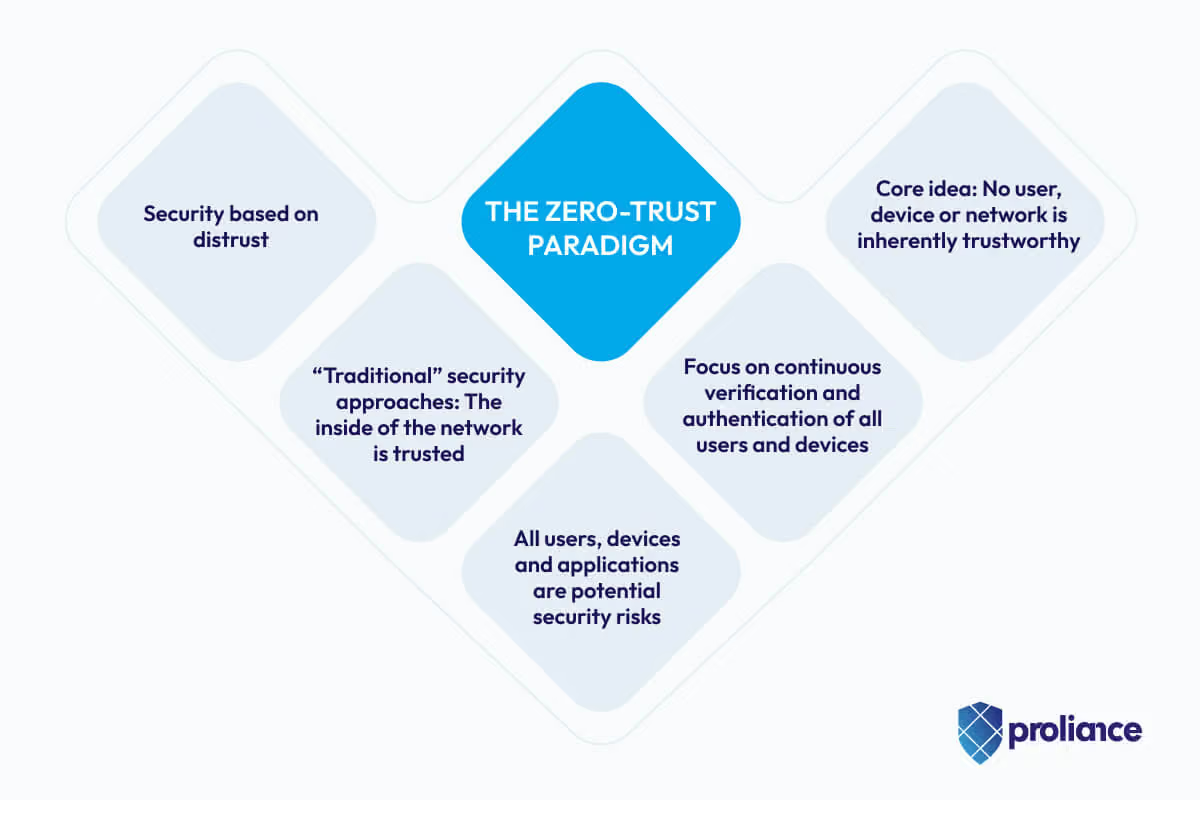
- The Zero Trust principle of "never trust, always verify" means that every entity must be verified, even from within the network.
- Zero Trust improves cybersecurity and helps with GDPR compliance – because secure networks mean better protection for personal customer, employee, and partner data.
Network security in transition: Why companies need new security concepts
8 out of 10 companies in Germany were victims of a cyberattack in 2024 and had to deal with data theft, espionage, or sabotage. In the past, companies could protect themselves from cyberattacks by specifically securing the outer boundaries of their corporate network (perimeter) against unauthorized external access. With this perimeter-based security approach, only trusted users were allowed to cross the boundary and move within the network.
However, digitalization has fundamentally changed the network architecture of many companies: cloud-first applications are increasingly replacing on-premise solutions, and the stationary PC has become obsolete in many areas. Today, employees can perform many of their tasks from anywhere with a laptop, a browser, and an internet connection.
But the price of this new flexibility for employees is a higher security risk for corporate data. Network boundaries are shifting, and companies need a new security strategy – such as the Zero Trust principle.
What is Zero Trust?
The smaller the attack surface, the harder it is for hackers to access your IT systems and data. That is why security experts recommend adopting a Zero Trust approach for permissions in information architectures.
The paradigm is: “Never trust, always verify” – meaning trust no one and verify everything – and is based on the principle of least privilege for all entities within the overall infrastructure. Simply put, this means that instead of trusting specific entities, companies should be inherently suspicious.
No users or systems are automatically trustworthy—even if they belong to your own company. Instead, permissions should be granted sparingly and every access right should be critically reviewed .

With an Information Security Management System (ISMS), you protect your company and digital data in a structured and sustainable way – from network access to emergency communication.
Zero Trust principles: How to act according to the Zero Trust model
There are various measures you can take if you want to implement Zero Trust for permissions. The following three examples show what you can do:
- In principle, it is important to reduce permissions to a minimum (least-privilege principle) and, above all, not to allow overly extensive privileges for individual users. Users and their devices should only be granted the access rights they need to do their jobs.
- Conduct regular audits and continuously verify the identity and status of users and devices to detect anomalies early. Also, analyze which users are communicating with which services to identify potential vulnerabilities.
- The network to be protected should be segmented —this increases the effort for attackers and allows you to better control access rights.

Why is Zero Trust important and who is it for?
The purpose of this approach is to Limit the scope of action for hackers. If an attacker breaches your corporate network and acts as a trusted user, they can quickly and almost unimpeded reach your most valuable data and cause immense damage . However, if compromised users and systems are required to authenticate at critical points even within a Zero Trust Architecture (ZTA), hackers are at a significant disadvantage.
A Zero Trust strategy is particularly important for companies that use cloud services and SaaS applications and need to ensure the protection of confidential data. Furthermore, industrial companies with IoT applications benefit from Zero Trust just as much as companies that want to collaborate securely with third-party providers and partners .
Pros and cons of the Zero Trust principle
Companies that rely on Zero Trust in their IT can use it to
- optimize their cybersecurity
- improve resilience against hackers
- protect customer data more effectively and strengthen trust in their security measures
- ensure compliance with GDPR and NIS2 more easily
- allow employees to work remotely in a secure manner
What are the disadvantages of Zero Trust?
If internal users are also not automatically trusted, this results in an increased authentication burden. The options for authentication should therefore be designed for employees to be designed to be as simple as possible, yet secure so that productivity does not suffer. Furthermore, retrofitting existing networks can be difficult.
Conclusion: Efficiently strengthening data protection and cybersecurity with Zero Trust
If you want to comprehensively protect your IT systems and the data of your customers and partners, approaches like the Zero Trust principle are indispensable. Before implementing a Zero Trust-based data and cybersecurity strategy, it is important to
- all legal requirements that apply to your industry in addition to the GDPR,
- IT and data protection risks within your company, and
- determine which technologies and security measures are suitable for your organization.
A clear authorization concept is also essential in the context of the Zero Trust principle. Furthermore, companies should define how to handle anomalies and what measures to take in the event of a crisis.
To ensure you get IT security right from the start while still having enough time for your core business, you can rely on the expertise and experience of Proliance : Together, we will determine what protection your data and systems require, when Zero Trust or perimeter protection is appropriate, which measures are necessary, and how you can achieve your security goals most efficiently.
Still have questions? We have the answers.
Zero Trust is a cybersecurity strategy where organizations verify every single entity within their IT networks and do not automatically trust every user and device. Previously, the focus was on protecting network perimeters. Today, due to the increasing interconnectedness of users, devices, and applications, it is more secure to consistently restrict access.
The most important principle of Zero Trust is "Never trust, always verify." Closely related is the principle of least privilege: organizations should minimize permissions and avoid granting individual users excessive privileges. Additionally, organizations should regularly validate the identity and status of users and devices to detect anomalies early.
Do you have further questions on this topic? Our experts will be happy to advise you free of charge.


.avif)