ISMS for SMEs: Best Practices for Systematic Information Security

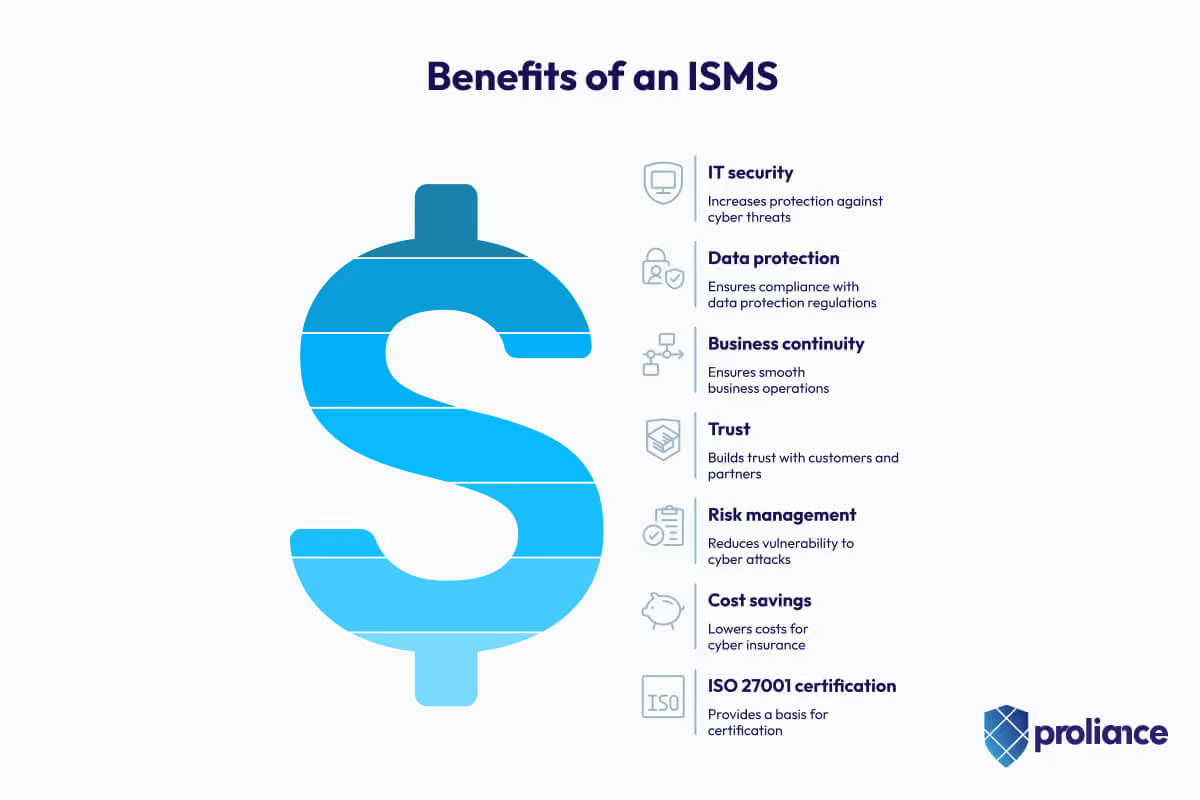
- An ISMS protects company data from unauthorized access, loss, and manipulation.
- An ISMS ensures the confidentiality, integrity, and availability of information.
- An ISMS increases customer trust and protects against legal consequences.
- With an ISMS, companies remain operational and avoid financial losses.
Why do SMEs need an ISMS?
Many small and medium-sized enterprises assume they are not worthwhile targets for cybercriminals. However, studies show a different picture. According to the BSI Report on the State of IT Security in Germany 2024 SMEs are among the three most frequently targeted groups. While SMEs are often not specifically targeted, they frequently fall victim to large-scale, automated attacks. Those who have not established structured protective measures are consequently left vulnerable.
For SMEs, such an incident often results in significant financial losses. Furthermore, business interruptions, reputational damage, and the loss of customer trust can seriously threaten the very existence of an SME.
An Information Security Management System (ISMS) helps SMEs take countermeasures. An ISMS creates a clear framework for identifying risks early, implementing targeted protective measures, and remaining capable of action in an emergency—all without requiring the resources of a large corporation.
💡 Quick definition: An ISMS is a set of procedures and rules that dictate how a company must handle processes and information assets to ensure continuous information security.

With Proliance's efficient Information Security Management, SMEs are often able to establish a future-proof ISMS in as little as 3 to 12 months.
ISMS components: What belongs in an information security management system?
An ISMS consists of several essential components that work together to ensure a high level of information security:
- Information security policies define the company's security goals and strategies, as well as employee responsibilities.
- Through regular risk analysis and risk assessment potential threats and vulnerabilities can be identified and measures for effective risk management can be established.
- An ISMS includes essential security measures, which encompass technical, organizational, and physical measures for information security.
- Employees must be regularly trained and made aware to build a culture of information security and encourage security-conscious behavior.
- Continuous monitoring and improvement are essential for an ISMS. It must be regularly reviewed and adapted to address new threats and developments.
- Comprehensive documentation of all processes, procedures, risks, and measures related to information security is another key component of an ISMS.
Why an ISMS is essential for these SMEs and industries
In principle, an information security management system is beneficial for companies of any size and industry that value the protection of their information and wish to comply with applicable legal and regulatory requirements.
An ISMS that meets the requirements of ISO 27001 is particularly relevant for SMEs that offer Software as a Service or are part of critical infrastructure, such as energy supply. Furthermore, SMEs in sectors like healthcare and finance should explore the benefits of an ISMS.
SMEs that want to work with automotive groups are often required to provide proof of TISAX® certification. Much of what this standard requires is often built upon ISMS structures.
When is ISMS certification worth it for SMEs?
As soon as information security becomes a sales criterion: For example, if ISO 27001 is regularly requested in tenders,a certificate shortens the audit process, reduces follow-up questions, and prevents losing out on a contract due to missing documentation.
Key standards for ISMS that SMEs should know
Implementing an ISMS is not only sound from a business perspective, but can also help SMEs in particular to reliably comply with various legal and regulatory requirements. The following laws and standards are relevant in the context of an ISMS:
Which requirements does your SME already meet? Our information security experts guide you through the gap analysis and save you valuable time.
Best practices for efficient ISMS implementation for SMEs
To ensure that introducing an ISMS does not become an endless project, the following best practices show how SMEs can set up their ISMS in a structured way, document it clearly, and effectively anchor it in everyday operations.
- An essential component of an ISMS is defined processesthat ensure security measures are effectively implemented and monitored.
- All relevant processes and measures must be documentedto ensure transparency and traceability.
- The ISMS should also be seamlessly integrated into existing business processes to ensure efficient and effective implementation.
- Since an ISMS is an integral part of corporate management and affects all areas of the company, it is usually initiated by the management level and implemented top-down throughout the company.
- An Information Security Officer (ISO) can act as a central point of contact to ensure that the implementation and operation of an ISMS run smoothly.
- In addition to management, IT experts and all other employees who come into contact with information in their daily work play an important role. To ensure that every single person can contribute to the success of the ISMS, transparent communication and change management methods are important.
- Due to increasing security requirements for companies, setting up an ISMS is a complex task. External consultants can provide relief with their expertise and time, helping to bridge resource gaps.
Tip: Learn about the specific steps required to build a robust ISMS.
Conclusion: Staying protected in the long term with an ISMS
A robust ISMS is essential for any company that strives for the highest level of information protection . With careful planning, you can improve your company's information security and respond more quickly to new requirements or threats. Furthermore, an ISMS contributes significantly to business continuity and compliance .
The Proliance team has the necessary expertiseto make the implementation of your ISMS efficient and, if required, prepare you for ISO 27001 or TISAX® certification.
{{infobox}}
PROLIANCE GmbH has no business relationship with the ENX Association. The mention of the TISAX® trademark does not imply any endorsement or statement by the trademark owner regarding the suitability of the services advertised here.
Still have questions? We have the answers.
An ISMS (Information Security Management System) is not a software system, but a systematic approach to protect information from unauthorized access, loss, and manipulation. It ensures confidentiality, integrity, and availability, strengthens customer trust, and helps avoid legal consequences and financial damages. Proliance supports SMEs in the efficient implementation of an ISMS.
Many companies use PDCA (Plan, Do, Check, Act): The Plan phase defines the framework, scope, objectives, priorities, responsibilities, and risks. The Do phase involves awareness and the implementation of organizational, technical, and physical measures. The Check phase reviews and documents effectiveness through audits. The Act phase continuously improves the ISMS. Proliance can support every step of your ISMS implementation, upon request.
Certification is worthwhile as soon as information security becomes a key selling point, for example, when ISO 27001 is required in tenders. A certificate streamlines review processes, minimizes follow-up questions, and prevents bids from failing due to insufficient documentation. TISAX® is particularly relevant for the automotive industry. Proliance prepares your ISMS for ISO 27001 or TISAX®.
Do you have further questions on this topic? Our experts will be happy to advise you free of charge.